
Al Azhar Mosque: History & Islamic Legacy
When exploring Islamic architecture in Cairo, few structures command as much reverence and historical significance as Al Azhar mosque. This magnificent 10th-century monument stands as both a spiritual sanctuary and an enduring symbol of Islamic scholarship that has shaped religious education for over a millennium.
What is Al Azhar Mosque?
Al Azhar mosque, known in Arabic as الجامع الأزهر (Al-Jāmiʿ al-Azhar), is one of Cairo's oldest mosques and home to the world's second-oldest continuously operating university. Founded in 970 CE during the Fatimid dynasty, this architectural masterpiece has welcomed worshippers, scholars, and visitors for more than 1,000 years.
The name "Al Azhar" translates to "the most resplendent" or "the most radiant," a fitting description for a mosque that has illuminated Islamic thought and education across centuries.
The Rich History of Al Azhar Mosque
Foundation and Early Years
The construction of Al Azhar mosque began in 970 CE under the orders of Fatimid Caliph Al-Mu'izz li-Din Allah, shortly after the Fatimids established Cairo as their capital. The mosque was completed in just two years, with the first Friday prayer held in 972 CE.
General Jawhar al-Siqilli, who led the Fatimid conquest of Egypt, oversaw the mosque's construction. From its inception, Al Azhar mosque was designed to serve dual purposes as both a place of worship and a center for Islamic learning, establishing a tradition that continues today.
Al Azhar University: The World's Oldest Degree-Granting Institution
In 975 CE, teaching circles began at Al Azhar mosque, marking the birth of what would become Al Azhar University. This institution predates many Western universities by centuries and holds the distinction of being the oldest continuously operating degree-granting university in the world.
Throughout history, Al Azhar mosque has attracted students from across the Islamic world, teaching Islamic jurisprudence, theology, Arabic grammar, Islamic astronomy, and philosophy. Today, Al Azhar University educates hundreds of thousands of students and maintains its position as one of Sunni Islam's most prestigious centers of learning.
Architectural Features of Al Azhar Mosque
The architecture of Al Azhar mosque represents a remarkable fusion of styles accumulated over centuries of expansion and renovation.
Original Fatimid Design
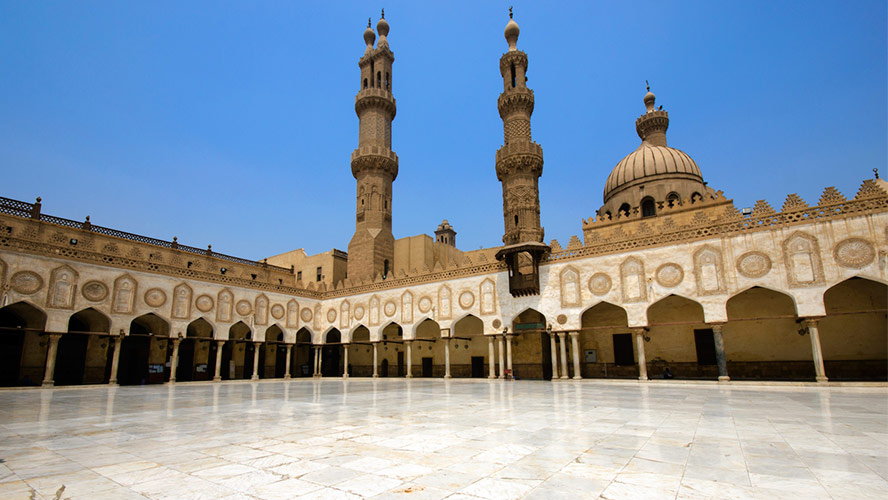
The original Fatimid structure featured a courtyard surrounded by arcades, with a prayer hall characterized by five aisles running parallel to the qibla wall. These early architectural elements, though modified over time, established the mosque's fundamental layout.
Mamluk Additions
The Mamluk period (1250-1517 CE) brought significant enhancements to Al Azhar mosque. The stunning main entrance, known as the Barber's Gate (Bab al-Muzayyin), dates from this era and showcases exquisite Mamluk stonework and geometric patterns.
Three of the mosque's minarets were constructed during Mamluk rule, each displaying the distinctive architectural features of their respective periods. The double-finial minaret built by Sultan Qaitbay in the 15th century remains one of the mosque's most recognizable features.
Ottoman Contributions
Under Ottoman rule, Al Azhar mosque received additional embellishments, including the elegant Ottoman-style minaret added by Sultan Abd al-Rahman Katkhuda in the 18th century. The mosque's current main facade largely reflects Ottoman architectural sensibilities.
Key Architectural Highlights
- The Central Courtyard: A spacious open area where students traditionally gathered for lessons
- Five Minarets: Each representing different architectural periods and styles
- The Mihrab: An ornately decorated prayer niche indicating the direction of Mecca
- Marble Columns: Supporting the prayer hall's arcade, many recycled from earlier Roman and Byzantine structures
- Decorative Elements: Intricate stucco work, carved wood, and Arabic calligraphy throughout
Visiting Al Azhar Mosque: Practical Information
Location and How to Get There
Al Azhar mosque is located in Islamic Cairo, specifically in the Al-Darb al-Ahmar district near the famous Khan el-Khalili bazaar. The mosque is easily accessible from central Cairo:
- By Metro: Take the metro to Ataba station, then walk or take a short taxi ride
- By Taxi or Uber: Simply request "Al Azhar mosque" or "الأزهر"
- On Foot: If exploring Islamic Cairo, the mosque is within walking distance of many historic sites
Opening Hours and Visiting Times
Al Azhar mosque welcomes visitors throughout the day, though specific hours may vary. Generally:
- Open daily except during prayer times
- Best visited during morning hours (9 AM - 11 AM)
- Modest dress required (covered shoulders and knees; women should bring a headscarf)
- Remove shoes before entering prayer areas
Entrance Fees
Unlike many mosques in Cairo that charge tourist entrance fees, Al Azhar mosque traditionally allows free entry for visitors, though donations are appreciated. As an active place of worship, visitors should be respectful and mindful of worshippers.
What to See Nearby
Al Azhar mosque's central location makes it an ideal starting point for exploring Islamic Cairo:
- Khan el-Khalili Bazaar: Cairo's famous market, just minutes away
- Al-Hussein Mosque: Another significant mosque nearby
- Historic Cairo Streets: Wander through centuries-old alleyways filled with traditional crafts
- Wikala of al-Ghuri: A restored caravanserai with regular cultural performances
The Religious and Cultural Significance of Al Azhar Mosque
A Center of Sunni Islamic Authority
Al Azhar mosque holds immense religious authority in the Sunni Islamic world. The Grand Imam of Al Azhar and the institution's Council of Senior Scholars issue fatwas (religious rulings) that carry weight across the Muslim world. Al Azhar mosque represents moderate Islamic thought and has historically positioned itself against extremism.
Educational Legacy
The teaching methodology developed at Al Azhar mosque influenced Islamic education globally. The traditional system of sitting in circles (halaqas) around scholars in the mosque's courtyard created an intimate learning environment that fostered deep understanding of Islamic sciences.
A Living Tradition
What makes Al Azhar mosque truly remarkable is that it remains a vibrant, functioning institution. While tourists photograph its architectural splendor, students continue studying in its classrooms, and worshippers fill its prayer halls five times daily, just as they have for over a thousand years.
Photography and Cultural Etiquette
When visiting Al Azhar mosque, keep these guidelines in mind:
- Photography is generally permitted in courtyard areas, but always ask permission
- Avoid photographing people at prayer
- Dress modestly out of respect for the sacred space
- Speak quietly and turn off mobile phones
- Follow the guidance of mosque staff
- Women may be asked to wear an abaya or cover provided at the entrance
Best Time to Visit Al Azhar Mosque
The ideal time to visit Cairo and Al Azhar mosque is during the cooler months from October to April. Summer temperatures can exceed 40°C (104°F), making exploration uncomfortable. Early morning visits offer the best light for photography and fewer crowds.
Avoid visiting during Friday prayers (around noon), when the mosque is filled with worshippers. Ramadan brings special energy to Al Azhar mosque, with evening prayers attracting large crowds, though daytime visits may be more restricted.
The Future of Al Azhar Mosque
Al Azhar mosque continues evolving while maintaining its historical essence. Recent restoration efforts have preserved architectural elements while modernizing facilities for students and visitors. The institution has embraced digital technology, offering online courses while maintaining traditional in-person instruction methods that have defined Al Azhar mosque for centuries.
Conclusion: Why Al Azhar Mosque Matters
Al Azhar mosque represents far more than architectural beauty or historical curiosity. It stands as a living bridge between past and present, embodying the continuity of Islamic scholarship, the evolution of architectural styles, and the enduring power of faith and education.
Whether you're a history enthusiast, architecture lover, spiritual seeker, or curious traveler, Al Azhar mosque offers profound insights into Islamic civilization's contributions to human knowledge. A visit to this remarkable institution connects you to a thousand-year tradition of learning that continues shaping minds and hearts today.
When planning your Cairo itinerary, make Al Azhar mosque a priority. Walk through its ancient courtyards, admire its minarets reaching toward the sky, and feel the weight of history in a place where knowledge has been treasured for more than a millennium.
