
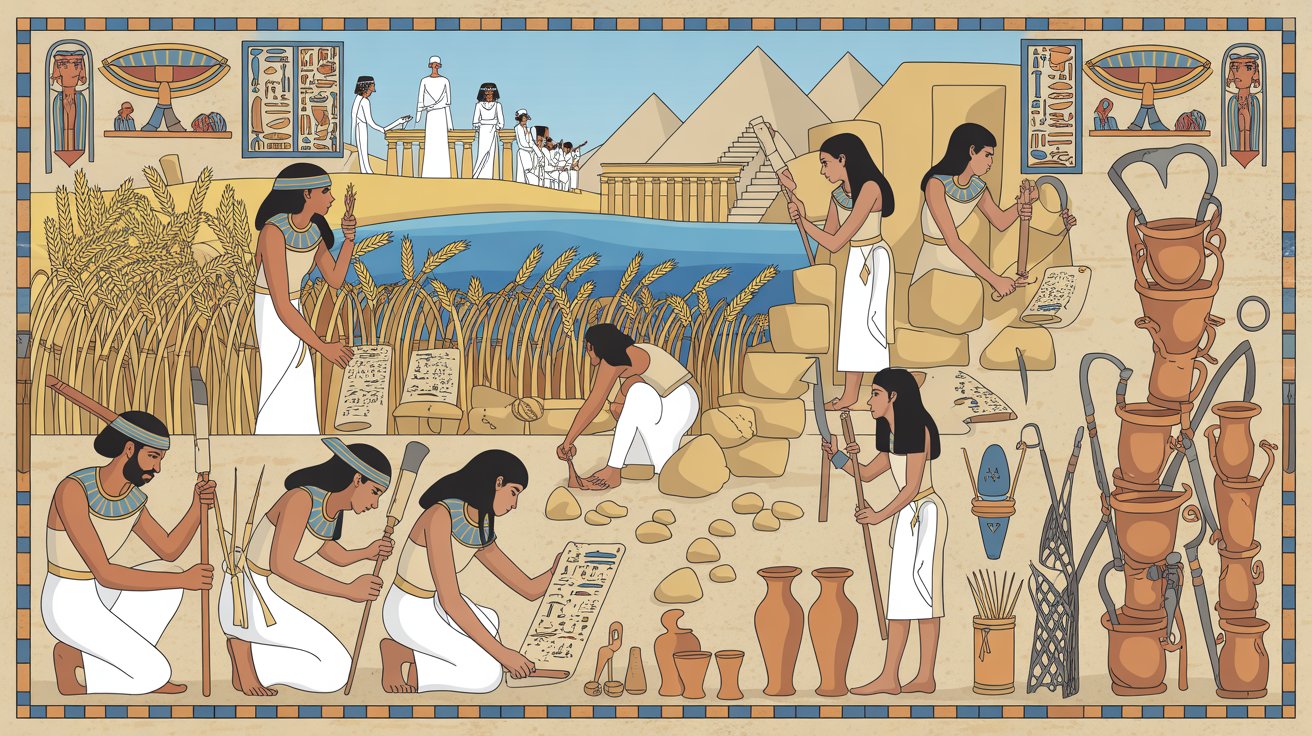
Ancient Egypt Occupations: Jobs in the Land of the Pharaohs
The civilization of ancient Egypt lasted for over 3,000 years, and during that time, a complex society developed with diverse ancient Egypt occupations that kept the kingdom functioning. From the mighty pharaoh to humble farmers, every person had a role to play in maintaining one of history's greatest civilizations.
The Social Hierarchy and Ancient Egypt Occupations
Ancient Egyptian society was structured like a pyramid, with the pharaoh at the top and peasants at the bottom. Understanding this hierarchy helps us appreciate how ancient Egypt occupations were organized and valued.
The Pharaoh and Royal Family
At the apex of Egyptian society stood the pharaoh, considered both a king and a living god. The pharaoh's job was to maintain ma'at (order and balance), lead military campaigns, commission building projects, and serve as the intermediary between the gods and the people.
Viziers and High Officials
The vizier was essentially the prime minister of ancient Egypt, overseeing government operations, collecting taxes, and administering justice. This was one of the most powerful ancient Egypt occupations outside the royal family.
Religious Occupations in Ancient Egypt
Religion permeated every aspect of Egyptian life, creating numerous specialized occupations.
Priests and Priestesses
Priests were among the most respected professionals in ancient Egypt occupations. They performed daily rituals, maintained temples, and conducted ceremonies for the gods. Different levels of priests existed, from high priests who wielded significant political power to lower-ranking priests who carried out daily temple maintenance.
Temple Workers
Beyond priests, temples employed numerous workers including musicians, singers, and dancers who performed during religious ceremonies. These ancient Egypt occupations were often hereditary, passed down through families.
Administrative and Scholarly Occupations
Scribes
Scribes held one of the most coveted ancient Egypt occupations. Literacy was rare, making scribes essential for record-keeping, correspondence, and administrative tasks. They recorded everything from tax collections to royal decrees, and their work has provided us with much of what we know about ancient Egypt today.
To become a scribe required years of education, but it offered a path to social advancement and exemption from manual labor and military service.
Tax Collectors
Tax collectors worked under scribes to gather payments from farmers and craftsmen. While not always popular, this was an important administrative role among ancient Egypt occupations.
Skilled Craftsmen and Artisans
Architects and Engineers
The magnificent pyramids, temples, and monuments of ancient Egypt required brilliant architects and engineers. These professionals designed structures that have lasted millennia, demonstrating remarkable mathematical and engineering knowledge.
Stonemasons and Construction Workers
Building the pyramids and temples required massive workforces. Contrary to popular belief, recent evidence suggests these workers were not slaves but paid laborers who worked in organized shifts. Construction was one of the largest employment sectors among ancient Egypt occupations.
Carpenters
Carpenters crafted furniture, boats, coffins, and other wooden items. Though wood was scarce in Egypt and often imported, skilled carpenters were highly valued for their ability to work with this precious material.
Metalworkers
Metalworkers created everything from tools and weapons to jewelry and decorative items. They worked with copper, bronze, gold, and silver, and their skills were essential to both daily life and religious practices.
Potters
Pottery was essential for storing food, water, and other goods. Potters used the Nile's clay to create vessels of various sizes and purposes, making this one of the most common ancient Egypt occupations.
Weavers and Textile Workers
Linen production was a major industry in ancient Egypt. Weavers, primarily women, created everything from simple garments to fine linen for the wealthy and for wrapping mummies.
Jewelers
Creating intricate jewelry for the living and the dead, jewelers worked with precious metals and semi-precious stones. Their creations have been found in tombs throughout Egypt, showcasing their exceptional craftsmanship.
Agricultural Occupations
Farmers
Farming was the backbone of ancient Egyptian society, and farmers represented the largest group among ancient Egypt occupations. They grew wheat, barley, flax, and vegetables, working in rhythm with the Nile's annual flood cycle.
The agricultural year was divided into three seasons: Akhet (flooding), Peret (planting), and Shemu (harvesting). Farmers paid taxes in the form of crops, which fed the rest of Egyptian society.
Irrigation Workers
Managing water from the Nile required specialized knowledge. Irrigation workers maintained canals, dikes, and shadufs (water-lifting devices) to ensure crops received adequate water.
Trade and Commerce
Merchants and Traders
Merchants facilitated trade both within Egypt and with foreign lands. They exchanged Egyptian goods like grain, papyrus, and linen for items like cedar wood from Lebanon, ivory from Africa, and lapis lazuli from Afghanistan.
Boat Builders and Sailors
The Nile was Egypt's highway, making boat building and sailing essential ancient Egypt occupations. Sailors transported goods, people, and building materials up and down the river.
Medical Professions
Physicians
Ancient Egyptian doctors were renowned throughout the ancient world. They specialized in different areas, with some focusing on eyes, others on teeth, and still others on internal ailments. Medical practice combined practical knowledge with magical incantations.
Embalmers
The practice of mummification created a unique profession in ancient Egypt. Embalmers prepared bodies for the afterlife, a process that could take 70 days and required extensive knowledge of anatomy and preservation techniques.
Military Occupations
Soldiers
Egypt's military protected the kingdom's borders and expanded its territory. Professional soldiers could rise through the ranks and receive land grants as payment. During peacetime, soldiers sometimes worked on building projects.
Chariot Drivers
Elite military units used chariots in battle. Chariot drivers required extensive training and were considered skilled warriors among ancient Egypt occupations.
Domestic Service
Servants
Wealthy households employed servants for cooking, cleaning, and childcare. While servants had lower social status, working for a powerful family could provide security and opportunities.
Hairdressers and Cosmeticians
Personal grooming was important in ancient Egypt, creating demand for hairdressers and those who prepared cosmetics and perfumes.
Entertainers
Musicians and Dancers
Music and dance played important roles in both religious ceremonies and secular entertainment. Musicians played harps, lutes, drums, and flutes, while dancers performed at banquets and festivals.
Storytellers
Oral tradition was important for entertainment and education. Storytellers shared tales of gods, pharaohs, and legendary heroes.
Women in Ancient Egypt Occupations
Women in ancient Egypt enjoyed more rights and opportunities than in many other ancient civilizations. While most worked in textile production or domestic roles, women could also become priestesses, musicians, dancers, physicians, and even business owners. Some women held significant religious power, such as the God's Wife of Amun, a high priestess role with considerable influence.
How Ancient Egypt Occupations Were Learned
Most ancient Egypt occupations were learned through apprenticeship, with children often following their parents' professions. Scribal schools provided formal education for those seeking administrative careers. This hereditary system ensured skills were preserved and passed down through generations.
Payment and Compensation
Ancient Egypt's economy was based primarily on barter rather than currency. Workers received payment in the form of grain, beer, bread, and other goods. The amount varied based on the occupation's importance and skill level. Scribes, physicians, and skilled craftsmen received more generous rations than laborers.
The Legacy of Ancient Egypt Occupations
The specialized occupations of ancient Egypt laid foundations for many modern professions. Their administrative systems, medical practices, architectural techniques, and artistic traditions influenced later civilizations and continue to fascinate us today.
The diversity of ancient Egypt occupations demonstrates that this was a sophisticated society with complex needs and remarkable organizational abilities. From the workers who built the pyramids to the scribes who recorded history, each person contributed to creating one of humanity's most enduring civilizations.
Understanding ancient Egypt occupations gives us insight into daily life along the Nile thousands of years ago and helps us appreciate the human stories behind the monuments and artifacts that survive today. Whether you're a student, history enthusiast, or simply curious about the past, exploring these ancient careers reveals the timeless human need for purpose, community, and meaningful work.
Ancient Egypt occupations reflected a complex, stratified society where everyone from the pharaoh to the farmer had a specific role to play. The specialization of labor allowed ancient Egypt to achieve remarkable feats in architecture, art, medicine, and governance that still inspire wonder today. By studying these ancient professions, we gain a deeper understanding of one of history's greatest civilizations and the people who built it.
