
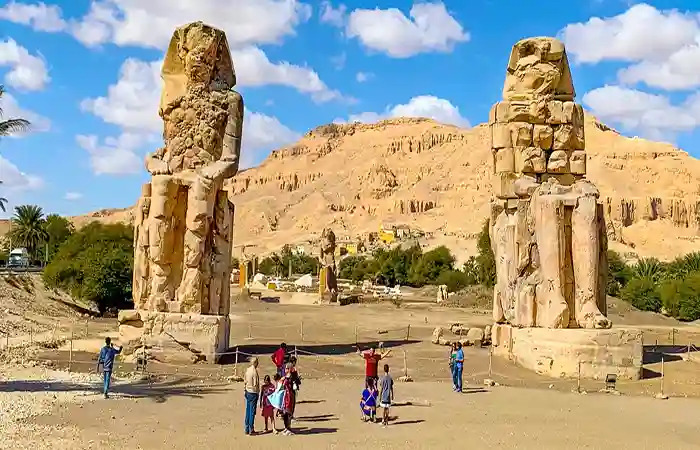
The Colossi of Memnon: Luxor's Ancient Guardians
Rising from the Theban plain like silent sentinels, the Colossi of Memnon have watched over Egypt's ancient capital for more than three millennia. These twin statues represent one of the most recognizable landmarks on the West Bank of Luxor, greeting visitors as they journey toward the Valley of the Kings and Queens.
What Are the Colossi of Memnon?
The Colossi of Memnon Luxor are two massive stone statues depicting Pharaoh Amenhotep III in a seated position. Each statue stands approximately 18 meters (60 feet) tall and weighs an estimated 720 tons. Carved from single blocks of quartzite sandstone, these monumental sculptures were transported over 675 kilometers from quarries near modern-day Cairo to their current location in Luxor.
Originally, these imposing figures flanked the entrance to Amenhotep III's mortuary temple, which was once the largest and most opulent temple complex in ancient Egypt. Today, while the temple itself has largely disappeared, the Colossi of Memnon Egypt remain standing as enduring testaments to ancient Egyptian architectural ambition and artistic skill.
The History Behind the Giants
Constructed around 1350 BCE during the 18th Dynasty, the colossi were part of Amenhotep III's grand mortuary temple. The pharaoh, who ruled during Egypt's golden age, commissioned this elaborate complex to honor his legacy and serve as a place of worship after his death.
Each statue depicts the pharaoh seated on a throne with his hands resting on his knees, wearing the royal headdress and traditional false beard. Smaller figures carved beside his legs represent his wife, Queen Tiye, and his mother, Mutemwiya. The intricate panels on the sides of the thrones feature the sema-tawy symbol, representing the unity of Upper and Lower Egypt.
Why Are They Called the Colossi of Memnon?
The name "Colossi of Memnon" came much later, during the Greco-Roman period. The Greeks mistakenly identified the statues with Memnon, the Ethiopian king who fought in the Trojan War according to Greek mythology. This misnomer has persisted through the centuries, despite the statues having no connection to the legendary hero.
The Singing Statue Phenomenon
One of the most fascinating aspects of the Luxor Colossi Memnon is the ancient mystery of the "singing statue." In 27 BCE, a powerful earthquake severely damaged the northern colossus, causing it to crack. Following this event, the statue began producing mysterious sounds at dawn, described as a haunting musical note or whistle.
Ancient travelers from across the Roman Empire journeyed to hear this phenomenon, believing it to be the voice of Memnon greeting his mother, Eos, the goddess of dawn. The sound was likely caused by rising temperatures at sunrise causing air to pass through the cracks in the porous stone.
The singing ceased in 199 CE when Roman Emperor Septimius Severus had the statue repaired, inadvertently silencing it forever. Numerous ancient inscriptions carved by Greek and Roman visitors still cover the lower portions of both statues, serving as ancient graffiti documenting their pilgrimages.
Visiting the Colossi of Memnon Today
The Colossi of Memnon Luxor remain easily accessible to modern visitors. Located on the West Bank of the Nile, just a short distance from the city center, these statues are often the first stop on tours of Luxor's west bank monuments.
Practical Information:
- The site is open daily from sunrise to sunset
- Admission is free, as the statues stand in an open area
- Best visited in the early morning or late afternoon to avoid crowds and harsh sunlight
- Allow 20-30 minutes for your visit
- Combine with nearby attractions like the Valley of the Kings, Hatshepsut's Temple, and the Valley of the Queens
What Makes These Statues Special?
Despite weathering, earthquakes, floods, and vandalism over 34 centuries, the Colossi of Memnon Egypt have survived remarkably well. They represent:
Exceptional Engineering: Moving and erecting these massive stones required sophisticated understanding of physics and logistics that astounds modern engineers.
Artistic Mastery: The fine details that remain visible demonstrate the high level of craftsmanship achieved by ancient Egyptian sculptors.
Historical Significance: They're among the few remnants of what was once Egypt's most magnificent mortuary temple.
Cultural Bridge: The Greek inscriptions and the Memnon legend show how different cultures interacted with and reinterpreted Egypt's monuments.
The Lost Temple
While the colossi have endured, Amenhotep III's mortuary temple has largely vanished. Annual Nile floods, stone robbing for other building projects, and the passage of time reduced this once-spectacular complex to scattered ruins. Archaeological excavations continue to uncover new elements of the temple, including additional statues, columns, and architectural fragments.
Recent conservation efforts have revealed that the temple covered approximately 35 hectares, making it larger than any other temple complex in Egypt. Ongoing research continues to shed light on the temple's original grandeur and the religious practices conducted there.
Photography Tips
The Colossi of Memnon Luxor offer excellent photography opportunities:
- Golden hour (early morning or late afternoon) provides the best lighting
- Stand between the statues for scale perspective shots
- Capture the agricultural fields in the background for context
- Detail shots reveal the ancient Greek and Roman inscriptions
- Consider visiting during sunset when the statues glow in warm light
Beyond the Statues
While the colossi themselves can be viewed in under an hour, the surrounding area holds additional interest. Small souvenir vendors offer local handicrafts, and the nearby village provides glimpses into modern Egyptian rural life. Many visitors use the site as a starting point for exploring Luxor's extensive West Bank archaeological zone.
Conclusion: Monuments That Transcend Time
The Colossi of Memnon stand as powerful reminders of ancient Egypt's extraordinary civilization. These twin giants have witnessed the rise and fall of empires, welcomed countless pilgrims and travelers, and continue to inspire awe in everyone who stands before them. Whether you're a history enthusiast, archaeology buff, or simply a curious traveler, visiting these ancient guardians offers a profound connection to one of humanity's greatest civilizations.
When planning your trip to Luxor, make sure the Colossi of Memnon Egypt are on your itinerary. Standing in their shadow, you'll understand why these silent sentinels have captivated imaginations for over three thousand years and continue to serve as iconic symbols of Egypt's magnificent past.
