
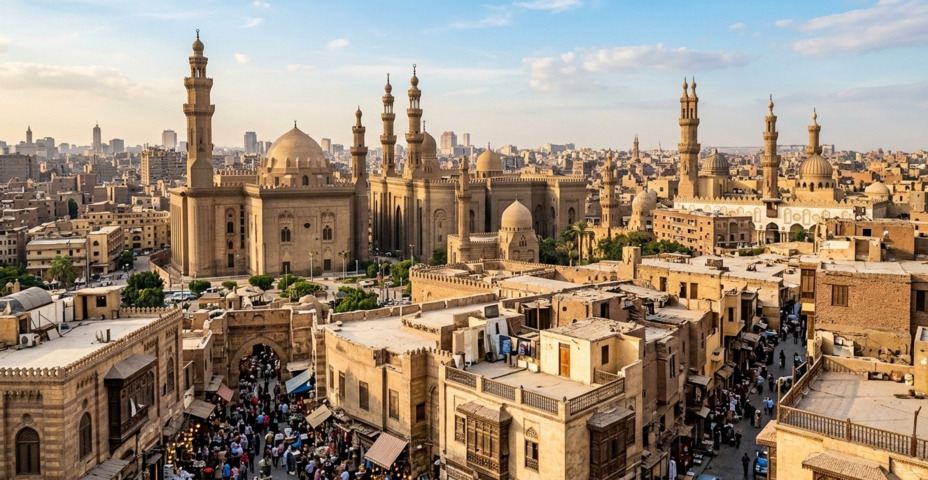
Islamic Cairo
Islamic Cairo is one of the most remarkable historic areas in the world. Located in the heart of Cairo, this district contains an extraordinary concentration of medieval Islamic monuments, making it one of the largest open-air museums of Islamic architecture on the planet.
With hundreds of mosques, madrasas, palaces, gates, and markets dating back more than a thousand years, Islamic Cairo reflects the political, religious, and cultural development of Egypt throughout the Islamic period. For travelers, historians, and architecture enthusiasts, exploring Islamic Cairo is like walking through the living history of the Islamic world.
What Is Islamic Cairo?
Islamic Cairo refers to the historic areas built during the many Islamic dynasties that ruled Egypt after the Arab conquest in the 7th century. These districts expanded over centuries under the Fatimid, Ayyubid, Mamluk, and Ottoman periods, each leaving behind architectural masterpieces and urban landmarks.
Today, Islamic Cairo forms a central part of Historic Cairo, a heritage area recognized by UNESCO as a World Heritage Site because of its exceptional cultural importance and architectural preservation.
The district stretches from the northern city gates down to the Citadel area, including historic streets like Al-Muizz and the famous Khan el-Khalili bazaar.
The Historical Development of Islamic Cairo
Early Islamic Foundations
The history of Islamic Cairo began after the Arab conquest of Egypt in 641 AD. The first Islamic capital in Egypt was founded in nearby Fustat, but the region that would become Cairo developed later.
In 969 AD, the Fatimid dynasty established a new royal city named Al-Qahira, which eventually evolved into modern Cairo. The Fatimids built palaces, mosques, and administrative centers that laid the foundation for the city’s Islamic character.
One of the most important institutions founded during this time was Al-Azhar Mosque, which later became associated with Al-Azhar University, one of the oldest and most influential Islamic educational institutions in the world.
The Ayyubid Era and the Citadel
In the 12th century, the great Muslim leader Saladin transformed Cairo’s defenses by constructing the famous Cairo Citadel. Built on a hill overlooking the city, the Citadel served as Egypt’s center of government for nearly 700 years.
This fortress complex protected Cairo from Crusader attacks and became the seat of power for successive dynasties.
The Golden Age of Mamluk Architecture
The Mamluk period (1250–1517) is considered the golden age of Islamic Cairo’s architecture. During this era, rulers and wealthy patrons built impressive religious complexes combining mosques, schools, hospitals, and mausoleums.
Some of the most magnificent monuments from this period still stand today, including the iconic Mosque-Madrasa of Sultan Hassan, widely regarded as one of the greatest achievements of Islamic architecture.
The city became a thriving cultural hub where trade, education, and religion flourished.
Major Attractions in Islamic Cairo
Islamic Cairo contains hundreds of historic monuments. However, several landmarks stand out as must-visit sites.
Al-Azhar Mosque and University
Al-Azhar Mosque is one of the most significant religious and academic centers in the Islamic world. Founded in 970 AD by the Fatimids, the mosque quickly developed into a leading institution for Islamic scholarship.
Today, it remains closely linked to Al-Azhar University, which continues to educate students from across the Muslim world.
Visitors admire its beautiful courtyards, elegant arcades, and historic minarets that reflect centuries of architectural additions.
The Citadel of Saladin
Dominating the skyline of Cairo is the massive Cairo Citadel. Built in the 12th century by Saladin, the Citadel served as Egypt’s military and political headquarters for centuries.
Inside the complex are several museums and mosques, the most famous being the majestic Mosque of Muhammad Ali.
This mosque, built in the 19th century in Ottoman style, features large domes, towering minarets, and walls covered in alabaster stone, which is why it is often called the Alabaster Mosque.
From the Citadel terraces, visitors can enjoy panoramic views of Cairo and even glimpse the pyramids on clear days.
Sultan Hassan Mosque and Madrasa
The monumental Mosque-Madrasa of Sultan Hassan is one of the largest and most impressive mosques ever built in the Islamic world.
Constructed in the 14th century, the complex served as both a mosque and a madrasa where scholars studied the four major schools of Sunni Islamic law.
The mosque is famous for:
-
Its massive stone walls
-
A huge central courtyard
-
Towering minarets
-
Intricate decorative details
Its scale and elegance make it one of the architectural masterpieces of the Mamluk era.
Al-Rifa'i Mosque
Located directly opposite Sultan Hassan Mosque is the elegant Al-Rifa'i Mosque.
Although completed in the 19th century, its design deliberately reflects the Mamluk style to complement the neighboring monument.
The mosque contains several royal tombs, including members of Egypt’s royal family and even the last Shah of Iran.
Khan el-Khalili Bazaar
No visit to Islamic Cairo is complete without exploring Khan el-Khalili, one of the most famous markets in the Middle East.
Established in the 14th century during the Mamluk era, the bazaar became a central hub for international trade.
Today, the market is filled with narrow alleys and traditional shops selling:
-
Handmade jewelry
-
Spices and perfumes
-
Traditional lanterns
-
Copper and brass crafts
-
Carpets and textiles
-
Egyptian souvenirs
The atmosphere is vibrant and colorful, especially in the evening when cafés and restaurants fill with visitors.
Al-Muizz Street: The Heart of Islamic Cairo
Al-Muizz Street is considered one of the most historically significant streets in the Islamic world.
Stretching through the heart of Islamic Cairo, this street contains an incredible concentration of medieval monuments including mosques, madrasas, sabils (public fountains), and historic houses.
Many historians consider it the greatest open-air museum of Islamic architecture anywhere in the world.
At night, the street becomes beautifully illuminated, creating a magical atmosphere for visitors.
Bab Zuweila
One of the last remaining gates of medieval Cairo is Bab Zuweila.
Built in the 11th century during the Fatimid era, the gate once served as the southern entrance to the city. Visitors can climb its twin minarets to enjoy spectacular views over Islamic Cairo.
Historically, the gate also served as a place where royal decrees were announced and important events took place.
Al-Hakim Mosque
Another remarkable Fatimid monument is Al-Hakim Mosque.
This mosque is notable for its fortress-like design, thick stone walls, and unique minarets. It was originally constructed in the late 10th century and later restored in modern times.
The mosque represents an early architectural style that influenced later Islamic buildings in Cairo.
Al Hussein Mosque
One of the most sacred and visited religious sites in Islamic Cairo is the historic Al-Hussein Mosque. Located near the famous Khan el-Khalili bazaar in the heart of the old city, the mosque is believed by many Muslims to house the head of Imam Hussein, the grandson of the Prophet Muhammad.
The mosque was originally built in 1154 during the Fatimid era and has been rebuilt and renovated several times throughout history. Today, the mosque features elegant white stone architecture, beautiful minarets, and richly decorated interiors that attract thousands of worshippers and visitors every day.
The square in front of Al Hussein Mosque is one of the most vibrant places in Islamic Cairo. Visitors will find traditional cafés, sweet shops, and bustling markets surrounding the mosque. In the evenings, the area becomes especially lively, with locals gathering to socialize, drink tea, and enjoy the historic atmosphere of old Cairo.
For many Egyptians, visiting Al Hussein Mosque is not only a religious experience but also an important cultural tradition that connects modern life with centuries of Islamic heritage.
Muhammad Ali Mosque
The magnificent Mosque of Muhammad Ali is one of the most recognizable landmarks in Cairo. Located inside the historic Cairo Citadel, the mosque dominates the skyline with its large central dome and tall pencil-shaped minarets.
Commissioned by Muhammad Ali Pasha in 1830 and completed in 1848, the mosque was inspired by the Ottoman architectural style found in Istanbul. Because its walls are covered in alabaster stone, it is often called the Alabaster Mosque.
Inside the mosque, visitors will find a spacious prayer hall decorated with intricate chandeliers, colorful stained glass windows, and beautiful Islamic calligraphy. The interior design reflects both Ottoman and Egyptian artistic influences.
The mosque also contains the tomb of Muhammad Ali Pasha, the Ottoman governor who modernized Egypt and founded the dynasty that ruled the country until the Egyptian Revolution of 1952.
In addition to its architectural beauty, the mosque offers breathtaking panoramic views over Cairo, making it one of the most popular tourist attractions in the city.
Ibn Tulun Mosque
Another architectural masterpiece in Islamic Cairo is the historic Mosque of Ibn Tulun, one of the oldest and largest mosques in Egypt.
Built between 876 and 879 AD by the Abbasid governor Ahmad ibn Tulun, the mosque is remarkable because it has survived largely in its original form for more than eleven centuries.
The mosque’s design reflects the architectural style of the Abbasid capital Samarra in Iraq. Its most distinctive feature is the unique spiral minaret, which resembles the famous minaret of the Great Mosque of Samarra.
The mosque also features a vast open courtyard surrounded by arcades and pointed arches. Unlike many other mosques in Cairo, Ibn Tulun Mosque has a calm and spacious atmosphere that allows visitors to appreciate its architectural simplicity and elegance.
Because of its historic authenticity and impressive scale, the mosque is considered one of the most important examples of early Islamic architecture in Egypt.
Visitors can even climb the spiral minaret to enjoy panoramic views of Islamic Cairo and the surrounding historic neighborhoods.
Cultural Life in Islamic Cairo
Islamic Cairo is not just a collection of historic monuments. It is also a vibrant living district where traditional crafts and local culture continue to thrive.
Artisans still produce handmade goods such as metalwork, wood carvings, textiles, and glass lamps using techniques passed down through generations.
Visitors can also enjoy traditional Egyptian cafés where locals gather to drink tea, smoke shisha, and discuss daily life.
Why Islamic Cairo Is One of the World’s Greatest Historic Districts
Islamic Cairo represents more than a thousand years of history, culture, and architectural achievement.
From the spiritual importance of Al-Azhar Mosque to the bustling streets of Khan el-Khalili, the district showcases the rich heritage that made Cairo one of the most influential cities in the Islamic world.
For anyone visiting Egypt, exploring Islamic Cairo offers an unforgettable journey through time, where ancient monuments, vibrant markets, and centuries-old traditions come together in one extraordinary destination.
FAQ About Islamic Cairo
Where is Islamic Cairo located?
Islamic Cairo is located in the historic center of Cairo, stretching between the Citadel and the old Fatimid city gates.
Why is Islamic Cairo important?
It contains one of the largest collections of medieval Islamic monuments in the world, representing centuries of architectural and cultural development.
Is Islamic Cairo a UNESCO World Heritage Site?
Yes, Islamic Cairo forms part of the Historic Cairo heritage area recognized by UNESCO.
How long should visitors spend in Islamic Cairo?
Most travelers spend at least a full day exploring the mosques, markets, and historic streets, though history lovers may spend several days discovering its many monuments.
