
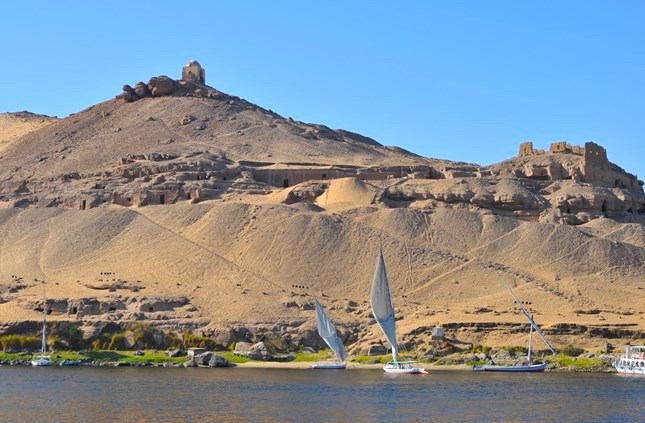
Qubbet el-Hawa: The Nobles’ Hill Overlooking Aswan
If you are exploring the ancient wonders of southern Egypt, Qubbet el-Hawa is one of the most fascinating yet underrated archaeological sites near Aswan. Overlooking the Nile from the west bank, this hill of rock-cut tombs offers breathtaking views and deep insights into Egypt’s Old and Middle Kingdom elite.
Where Is Qubbet el-Hawa?
Qubbet el-Hawa is located on the west bank of the Nile River, directly opposite the modern city of Aswan in southern Egypt. The site sits on a hilltop that provides panoramic views of the Nile Valley, Elephantine Island, and the surrounding desert landscape.
The name “Qubbet el-Hawa” translates to “Dome of the Wind,” referring to a small Islamic-era dome at the summit of the hill.
Historical Significance of Qubbet el-Hawa
Qubbet el-Hawa served as the burial site for nobles, governors, and high officials of Aswan during the Old Kingdom (around 2686–2181 BCE) and the Middle Kingdom (around 2055–1650 BCE).
These officials played a crucial role in:
-
Managing trade routes to Nubia
-
Protecting Egypt’s southern border
-
Organizing military expeditions
-
Supervising quarrying and mining activities
Many of the tombs contain inscriptions detailing diplomatic missions to Nubia and trade expeditions deep into Africa, offering rare historical documentation of Egypt’s foreign relations.
Architecture and Tomb Design
The tombs at Qubbet el-Hawa are carved directly into the sandstone cliffs. Their design typically includes:
-
A large entrance façade
-
Pillared halls
-
Burial chambers
-
Decorative inscriptions and reliefs
Although less decorated than royal tombs in Luxor, the tombs here are historically rich. Wall inscriptions often include autobiographies of the tomb owners, describing their achievements and loyalty to the pharaoh.
Some tombs still preserve painted scenes showing daily life, trade expeditions, and religious rituals.
Notable Tombs at Qubbet el-Hawa
Among the most important tombs at Qubbet el-Hawa are:
Tomb of Harkhuf
Harkhuf was a governor during the Sixth Dynasty. His tomb inscriptions describe expeditions to Nubia and mention bringing back exotic goods — and even a pygmy — for Pharaoh Pepi II. These inscriptions are among the most famous autobiographical texts from the Old Kingdom.
Tomb of Sarenput I
Dating to the Middle Kingdom, this tomb features well-preserved columns and inscriptions. Sarenput was a powerful local governor under Senusret I.
Archaeological Discoveries
Recent excavations have revealed:
-
Intact burial shafts
-
Mummies in excellent condition
-
Family burial complexes
-
Artifacts including pottery, jewelry, and wooden coffins
Spanish archaeological missions have been particularly active in uncovering new findings at the site, shedding light on family life and burial customs of provincial elites.
Why Visit Qubbet el-Hawa?
If you are visiting Aswan, Qubbet el-Hawa offers:
-
Stunning Nile sunset views
-
Fewer crowds compared to major temples
-
Unique insight into non-royal elite life
-
Excellent photography opportunities
It pairs perfectly with a visit to nearby Elephantine Island and the famous Temple of Philae.
Best Time to Visit
The ideal time to visit Qubbet el-Hawa is between October and April when temperatures in Aswan are cooler. Morning visits are recommended, as climbing the hill can be challenging under the midday sun.
How to Get There
You can reach Qubbet el-Hawa by:
-
Taking a local ferry to the west bank from Aswan.
-
Hiring a boat from the Corniche.
-
Arranging a guided tour.
From the riverbank, you will need to climb a staircase to reach the tombs.
Cultural and Religious Importance
At the top of the hill stands a small Islamic shrine dedicated to a local saint. This later addition shows how the site remained spiritually significant for centuries after the pharaonic period.
Final Thoughts
Qubbet el-Hawa is a hidden archaeological treasure overlooking Aswan. While Egypt is famous for its grand temples and pyramids, this hill of noble tombs reveals the powerful provincial leaders who helped shape ancient Egyptian history.
If you want a deeper understanding of southern Egypt’s past beyond the major tourist sites, Qubbet el-Hawa deserves a place on your itinerary.
FAQ About Qubbet el-Hawa
What does Qubbet el-Hawa mean?
It means “Dome of the Wind,” referring to the small domed shrine located at the top of the hill.
How old is Qubbet el-Hawa?
The tombs date back to the Old Kingdom (around 4,500 years ago) and continued to be used into the Middle Kingdom.
Is Qubbet el-Hawa worth visiting?
Yes. It offers unique historical inscriptions, impressive views of the Nile, and a quieter alternative to larger temple complexes.
How long does it take to visit?
Most visitors spend 1–2 hours exploring the tombs and enjoying the views.
Is it suitable for children?
Older children can visit, but the climb may be physically demanding for very young kids.
