
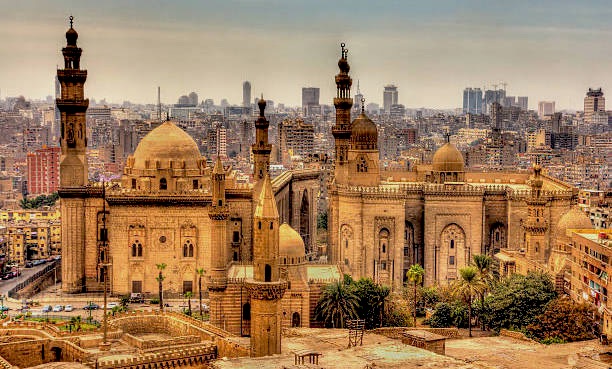
Sultan Hassan Mosque and Madrasa: A Masterpiece of Mamluk Architecture in Cairo
The Sultan Hassan Mosque and Madrasa is one of the most magnificent monuments of medieval Islamic architecture. Located in the heart of historic Cairo near the famous Saladin Citadel of Cairo, this monumental complex reflects the power, ambition, and artistic brilliance of the Mamluk Sultanate.
Built in the 14th century, the mosque and madrasa were designed not only as a place of worship but also as an important center of Islamic learning. Today, it stands as one of the greatest architectural achievements in the Islamic world and remains a highlight of Islamic Cairo.
The History of Sultan Hassan Mosque and Madrasa
The mosque was commissioned by Sultan an-Nasir Hasan, who ruled Egypt during the mid-14th century. Construction began in 1356 CE and continued for several years during a turbulent period of political conflict within the Mamluk court.
Despite the instability of the time, Sultan Hassan envisioned an enormous religious complex that would symbolize both faith and royal authority. The project required massive resources, skilled craftsmen, and innovative architectural techniques.
Unfortunately, Sultan Hassan was assassinated in 1361 CE before the completion of the building. However, the mosque was eventually finished and quickly became one of Cairo’s most prestigious religious institutions.
Architectural Brilliance of the Mosque
The Sultan Hassan Mosque and Madrasa is considered one of the most impressive examples of Mamluk architecture.
Monumental Scale
The complex is enormous even by modern standards. Its towering walls dominate the skyline of historic Cairo, and the main portal rises nearly 38 meters (125 feet) high. The massive stone façade was designed to impress visitors and emphasize the power of the Mamluk rulers.
The Grand Courtyard
At the heart of the complex lies a large open courtyard surrounded by four monumental iwans (vaulted halls). Each iwan represents one of the four major schools of Sunni Islamic jurisprudence:
-
Hanafi school
-
Maliki school
-
Shafi'i school
-
Hanbali school
Students from across the Islamic world came here to study theology, law, and religious sciences.
The Majestic Dome and Minarets
The mosque originally featured a magnificent wooden dome above the mausoleum chamber of Sultan Hassan. Although the original dome collapsed centuries later, it has been reconstructed several times.
The complex also includes towering minarets, one of which partially collapsed during construction—an event that reportedly caused widespread panic in Cairo.
A Center of Education and Worship
Unlike many mosques that served purely religious functions, the Sultan Hassan Mosque and Madrasa was designed as a full educational institution.
The madrasa provided accommodation and classrooms for students studying Islamic law, Quranic interpretation, and Arabic grammar. Scholars gathered here to debate theology and teach future judges and scholars.
Because of its academic importance, the complex quickly became one of the most respected centers of Islamic scholarship in Cairo.
Strategic Location in Islamic Cairo
The mosque’s location opposite the Saladin Citadel of Cairo was not accidental. The site allowed the structure to visually dominate the area and symbolize the balance between religious authority and political power.
Today, the mosque stands near other important historic monuments such as the Al-Rifa'i Mosque, creating one of the most spectacular architectural squares in Cairo.
Visitors exploring Historic Cairo often consider this area one of the most impressive in the city.
Artistic Details and Interior Decoration
The mosque’s interior showcases remarkable craftsmanship typical of the Mamluk period.
Highlights include:
-
Intricate marble paneling
-
Decorative muqarnas (stalactite-like carvings)
-
Elegant Quranic calligraphy
-
Beautiful geometric stone patterns
The mihrab (prayer niche) and minbar (pulpit) are especially admired for their exquisite marble mosaics and carved stone details.
Even centuries after its construction, the artistic quality of the decoration continues to amaze historians and architects.
Visiting Sultan Hassan Mosque Today
Today, the Sultan Hassan Mosque and Madrasa is one of the most popular historical attractions in Cairo. Tourists, historians, and architecture enthusiasts visit the site to admire its grandeur and learn about the golden age of Mamluk architecture.
The mosque remains an active place of worship while also serving as an important historical monument. Its massive stone structure has survived earthquakes, wars, and centuries of urban change.
Standing inside the courtyard, visitors can truly appreciate the scale and beauty of one of the greatest monuments of medieval Islamic civilization.
Why Sultan Hassan Mosque Is One of Cairo’s Greatest Monuments
There are many historic mosques in Cairo, but the Sultan Hassan Mosque stands out for several reasons:
-
One of the largest mosques of the medieval Islamic world
-
A masterpiece of Mamluk architectural design
-
A historic center of Islamic scholarship
-
A major landmark within Islamic Cairo
-
An enduring symbol of 14th-century Egyptian power and culture
For travelers exploring Cairo’s rich heritage, this mosque is an essential stop.
FAQ About Sultan Hassan Mosque and Madrasa
When was Sultan Hassan Mosque built?
Construction began in 1356 CE during the reign of Sultan an-Nasir Hasan and was completed a few years later in the 14th century.
Why is the mosque also called a madrasa?
Because it functioned as both a mosque and a religious school, teaching the four major Sunni schools of Islamic law.
Where is Sultan Hassan Mosque located?
It is located in Islamic Cairo, directly facing the Saladin Citadel of Cairo.
Why is the mosque historically important?
The complex represents the peak of Mamluk architecture, combining monumental scale, advanced engineering, and a strong educational mission.
