
Meanings of Ancient Egyptian Symbols: A Complete Guide to Sacred Icons
Ancient Egypt has captivated humanity for millennia, and nowhere is this fascination more evident than in the mysterious symbols that adorned temples, tombs, and papyri. Understanding the meanings of ancient Egyptian symbols offers a window into one of history's most sophisticated civilizations. This comprehensive guide explores the most significant Egyptian icons and their profound symbolism.
The Ankh: Symbol of Eternal Life
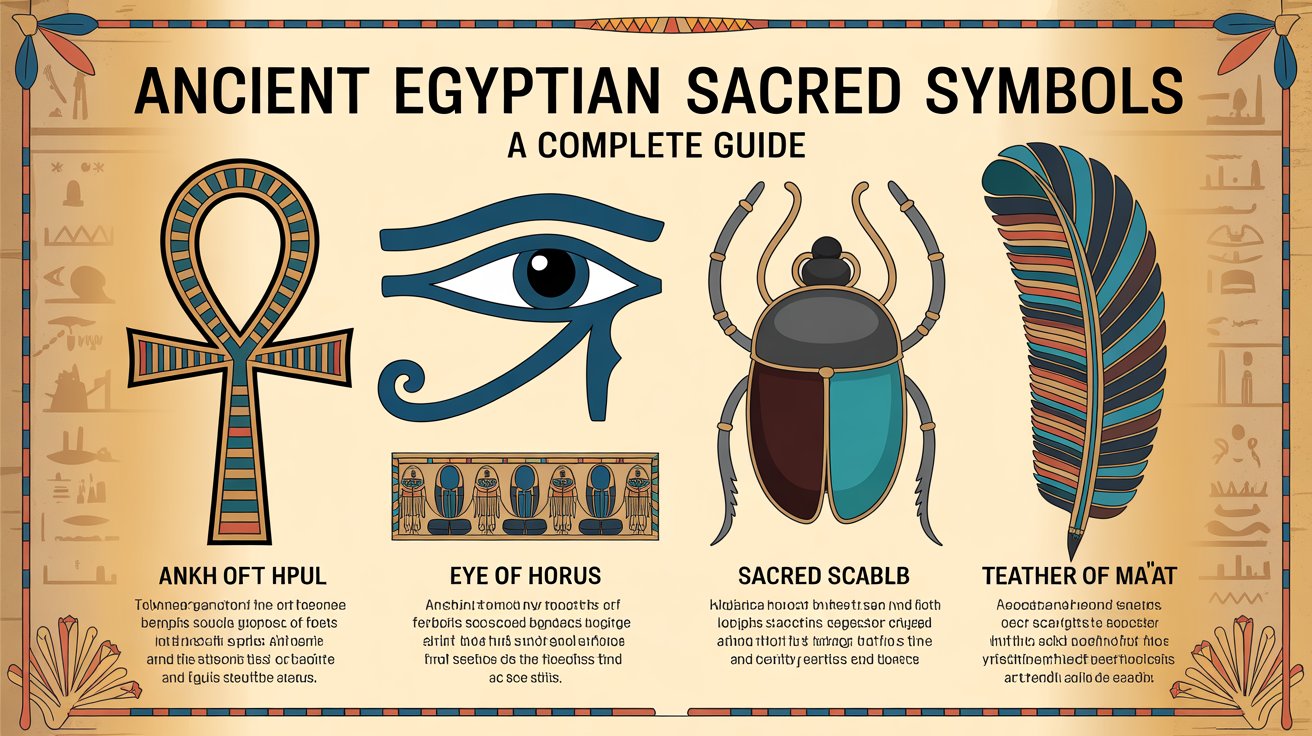
The ankh is perhaps the most recognizable of all ancient Egyptian symbols. Resembling a cross with a loop at the top, the ankh represented eternal life and was often called the "key of life." Gods and pharaohs were frequently depicted holding the ankh, symbolizing their power to give and sustain life. The meanings of ancient Egyptian symbols like the ankh extended beyond mortality—it represented the union of masculine and feminine principles, the balance between earth and heaven.
The Eye of Horus: Protection and Healing
One of the most powerful meanings of ancient Egyptian symbols belongs to the Eye of Horus, or "Wadjet." This symbol depicted a stylized eye with distinctive markings beneath it, representing the eye of the falcon-headed god Horus. According to mythology, Horus lost his eye in battle with Set, and it was magically restored by Thoth. The Eye of Horus became a symbol of protection, royal power, and good health. Ancient Egyptians used it as an amulet to ward off evil and as a mathematical symbol representing fractions.
The Scarab Beetle: Rebirth and Transformation
The scarab beetle held profound significance in ancient Egyptian culture. Observing how scarab beetles rolled balls of dung across the sand, Egyptians associated them with Khepri, the god who rolled the sun across the sky each day. Among the meanings of ancient Egyptian symbols, the scarab represented transformation, rebirth, and resurrection. Scarab amulets were placed over the hearts of mummified bodies to ensure safe passage to the afterlife.
The Djed Pillar: Stability and Endurance
The djed pillar resembled a vertical column with horizontal lines crossing near the top. This symbol represented stability, strength, and endurance. Associated with Osiris, god of the underworld, the djed was believed to be his backbone. During ceremonies, the ritual raising of the djed pillar symbolized Osiris's triumph over death and the promise of resurrection. Understanding the meanings of ancient Egyptian symbols like the djed reveals how deeply spirituality permeated daily Egyptian life.
The Was Scepter: Divine Power and Authority
The was scepter featured a long staff with a forked base and an animal head at the top, typically representing the god Set. This symbol denoted power, dominion, and control over chaos. Gods were frequently shown holding the was scepter, demonstrating their authority over the forces of nature and the universe.
The Uraeus: Royal Protection
The uraeus depicted a rearing cobra and was one of the most important royal symbols. Worn on the pharaoh's crown, the uraeus represented sovereignty, divine authority, and protection. According to mythology, the cobra would spit fire at the pharaoh's enemies, defending the ruler from harm.
The Feather of Ma'at: Truth and Justice
Ma'at's feather symbolized truth, justice, harmony, and cosmic order. In the famous judgment scene from the Book of the Dead, the deceased's heart was weighed against Ma'at's feather. If the heart was lighter than the feather, the soul could enter the afterlife. This symbol embodied the Egyptian concept of living in accordance with universal laws.
The Lotus Flower: Creation and Rebirth
The lotus held special significance because it closed at night and sank beneath the water, only to emerge and bloom again at dawn. This behavior made it a powerful symbol of the sun, creation, and rebirth. The blue lotus, in particular, was associated with the creation myth where the sun god Ra emerged from a lotus at the beginning of time.
The Tyet: Isis Knot
Also called the Isis knot, the tyet resembled an ankh with arms curved downward. This symbol was associated with the goddess Isis and represented life, welfare, and protection. Red jasper tyet amulets were often placed with mummies to invoke Isis's protective power in the afterlife.
The Shen Ring: Eternity and Protection
The shen ring was a circle of rope with a horizontal line at the bottom, symbolizing eternity, infinity, and protection. Gods and goddesses were often depicted holding shen rings, and the symbol appeared on amulets to provide divine protection. The cartouche, which enclosed royal names in hieroglyphics, evolved from the shen ring.
The Ba: Human Soul
The ba was depicted as a human-headed bird and represented the personality or soul of an individual. Ancient Egyptians believed the ba could travel between the world of the living and the dead. After death, the ba would reunite with the ka (life force) to form the akh, the transformed spirit that could live eternally.
The Ouroboros: Cyclical Nature
The ouroboros depicted a serpent eating its own tail, forming a perfect circle. This symbol represented the cyclical nature of time, the eternal return, and the unity of all things. It embodied the concept that endings are also beginnings, and that life emerges from death.
Why Understanding These Symbols Matters Today
The meanings of ancient Egyptian symbols continue to resonate in modern culture. These icons appear in jewelry, tattoos, art, and popular media, often carrying forward their ancient associations with protection, wisdom, and spiritual power. By understanding their original context and significance, we gain insight into how ancient Egyptians viewed life, death, divinity, and the cosmos.
Egyptian symbols were never mere decoration—they were powerful tools believed to have magical properties. Hieroglyphics themselves combined phonetic elements with symbolic meanings, making the written word a form of sacred art. Every symbol carried layers of meaning that could vary depending on context, color, and placement.
Conclusion: The Enduring Legacy of Egyptian Symbolism
The meanings of ancient Egyptian symbols reveal a civilization deeply concerned with balance, order, protection, and the afterlife. These symbols formed a visual language that communicated religious beliefs, political authority, and magical power. From the life-giving ankh to the protective Eye of Horus, each symbol played a specific role in Egyptian society and spirituality.
Today, as we study these ancient icons, we discover universal themes that transcend time—the human desire for protection, the quest for meaning, and the hope for life beyond death. The symbols of ancient Egypt continue to fascinate because they speak to fundamental aspects of human experience, connecting us across millennia to one of history's greatest civilizations.
Whether you're a history enthusiast, spiritual seeker, or simply curious about ancient cultures, understanding the meanings of ancient Egyptian symbols enriches our appreciation of this remarkable civilization and its lasting influence on human culture.
