
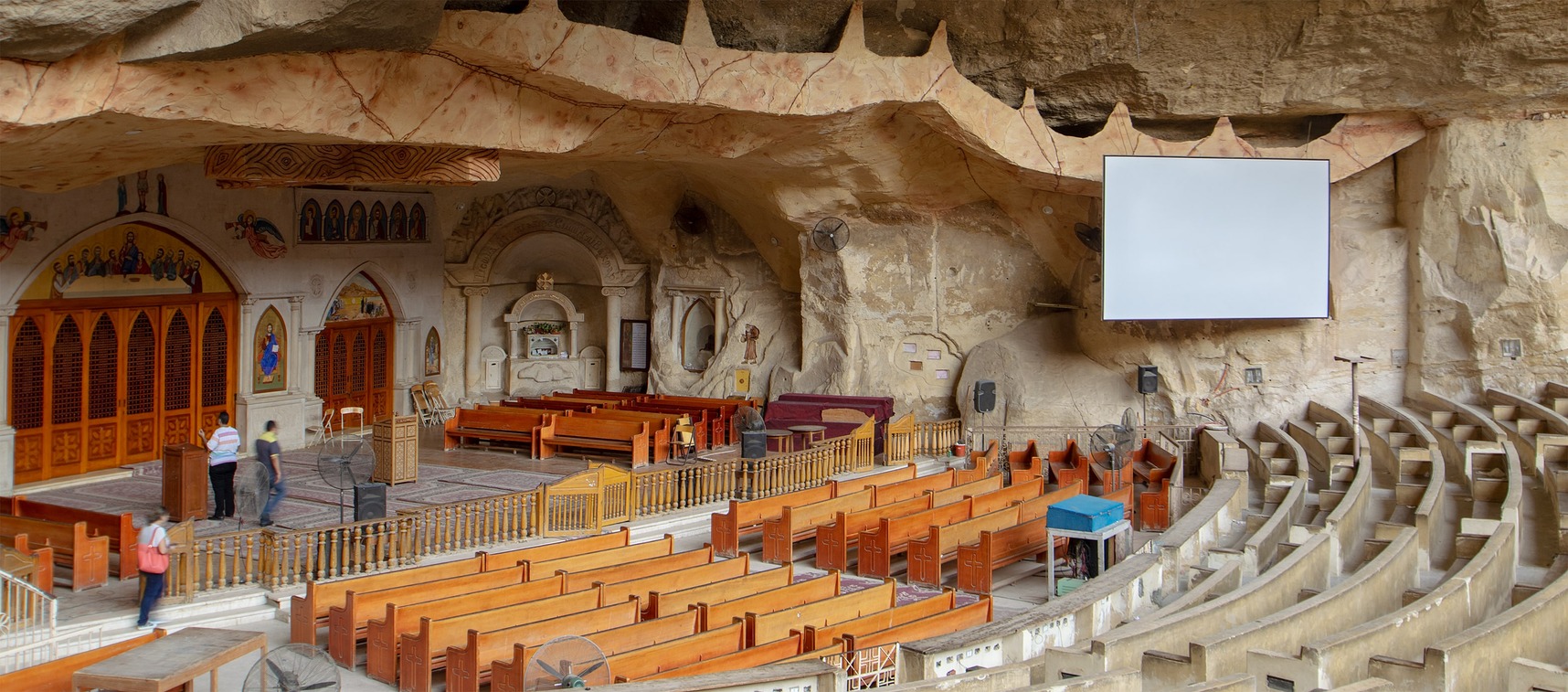
The Cave Church: A Testament of Faith Carved in Stone
Hidden within Cairo's Mokattam Hills lies one of the most extraordinary religious sanctuaries in the world the Cave Church, officially known as the Monastery of Saint Simon the Tanner. This remarkable complex of worship spaces carved directly into the mountain rock stands as a powerful testament to faith, perseverance, and the enduring spirit of Egypt's Coptic Christian community.
Discovering the Cave Church
Located atop Mokattam Mountain in southeastern Cairo, the Cave Church sits in an area known as Zabbaleen City, home to Cairo's garbage collectors and recyclers. While the journey through "Garbage City" might seem unconventional for reaching a place of worship, the church serves as a spiritual hub for the significant Coptic Christian community and has become one of Cairo's most unique tourist destinations.
The Cave Church is one of the largest churches in Egypt, the Middle East, and the world, with a seating capacity of 20,000, making it not just an architectural marvel but also a significant gathering place for worship and pilgrimage.
The Legend of Saint Simon the Tanner
The monastery takes its name from Saint Simon the Tanner, a humble 10th-century Coptic saint whose story has become legendary. Simon lived during the rule of the Muslim Fatimid Caliph al-Muizz Lideenillah and worked as a tanner, cobbler, and shoemaker.
The miraculous story begins with a challenge. During a religious debate, a Jewish minister named Yaqub Ibn Yusuf Ibn Killis quoted Matthew 17:20 about faith moving mountains and demanded that Coptic Pope Abraam prove his faith. The Caliph seized this opportunity and ordered the Pope to move Mokattam Mountain.
After three days of prayers and fasting by the Copts throughout Egypt, Pope Abraam was directed by the Holy Virgin Mary to choose St. Simon. According to tradition, when the people stood up to worship, the mountain thrust up and the sun could be seen from under it. This occurred three times before Simon mysteriously disappeared, demonstrating his profound humility.
The miracle had lasting consequences. The Caliph, shaking with fear, embraced the Pope warmly, marking the beginning of a long friendship. In commemoration of this miracle, the Coptic Orthodox Church observes three extra days of fasting before the Nativity Fast.
A Modern Sanctuary Built in the 1970s
While the miracle dates to 979 AD, the church was built in the 1970s and carved directly into the rock of the cave. Beginning in the 1970s, Father Simaan started to hold worship services in the cave and began mutual aid, support for the poorest and health services, eventually leading to the creation of a hospital.
The monastery complex actually consists of multiple worship spaces. It contains six churches carved directly into the rocky core of the mountain, including St. Paul's Church, St. Mark's Church, and St. Simon the Tanner's Hall.
Extraordinary Artwork and Biblical Carvings
One of the most remarkable features of the Cave Church is its stunning artwork. Polish artist Mario spent more than two decades carving the rugged insides of the seven cave churches and chapels with designs inspired by biblical stories.
The Cave Church is adorned with sculptures and carvings that depict biblical stories, including the birth of Jesus, the resurrection of Lazarus, and the story of Joseph and Zuleikha. The artistry transforms the cave walls into a visual narrative of Christian faith and history.
According to Mario himself, his work serves a profound spiritual purpose. Each sculpture takes anywhere from five days to six months to complete, depending on the complexity of the design. The carvings tell not only biblical stories but also chronicle the life and miracles of Saint Simon himself.
A Living Community of Faith
The Cave Church is far more than a historical monument—it remains a vibrant center of worship and community service. The monastery includes an educational center, a kindergarten, a school for the deaf and dumb, and literacy and vocational courses.
The monastery conducts regular services such as mass and other religious activities, and Saint Simon is remembered annually on November 26th. The church draws pilgrims from across Egypt and around the world, with many seeking spiritual healing and divine connection.
The congregation predominantly consists of the Zabbaleen community. Approximately 90% of Zabbaleen residents are Coptic Christians, and the church serves as their spiritual anchor in one of Cairo's most challenging neighborhoods.
Visiting the Cave Church
For those wishing to experience this extraordinary site, reaching the Cave Church requires traveling through the Zabbaleen community. While the journey through Garbage City might initially appear daunting, visitors consistently describe the experience as transformative.
The church features a large open space, high ceilings, and stone walls, with some areas adorned with intricate carvings and religious icons. From its elevated position on Mokattam Mountain, the monastery offers commanding views of the Cairo megalopolis below, creating a striking contrast between the spiritual sanctuary and the bustling city.
A Symbol of Hope and Resilience
The Cave Church represents something profound about faith and community resilience. Built in one of Cairo's poorest neighborhoods, carved into solid rock through years of dedicated labor, it stands as a monument to what believers can accomplish through determination and spiritual conviction.
The monastery serves multiple roles simultaneously: a place of worship accommodating thousands, a community center providing education and social services, a pilgrimage destination drawing visitors worldwide, and a living testament to the enduring story of Saint Simon's miracle more than a thousand years ago.
For Christians visiting Cairo, the Cave Church offers an essential glimpse into Egypt's Coptic heritage. For all visitors, regardless of faith, it provides an unforgettable experience—a place where ancient legend, modern community, and extraordinary artistry converge within the stone walls of Mokattam Mountain.
Whether you come seeking spiritual enlightenment, historical understanding, or simply to witness one of the world's most unique religious sites, the Cave Church delivers an experience that resonates long after you descend from the mountain. In a region often defined by its ancient pharaonic monuments, this modern sanctuary carved from living rock reminds us that faith continues to move mountains—sometimes literally, sometimes metaphorically, but always powerfully.
- Location: Mokattam Hills, Manshiyat Nasir, Cairo, Egypt
- Access: Through Zabbaleen City (Garbage City)
- Best visited: During regular worship services or by guided tour
- Capacity: 20,000 worshippers
- Special features: Seven cave churches, biblical rock carvings, community services
The Cave Church stands not merely as a destination but as a living demonstration that extraordinary beauty and profound faith can flourish in the most unexpected places.
