
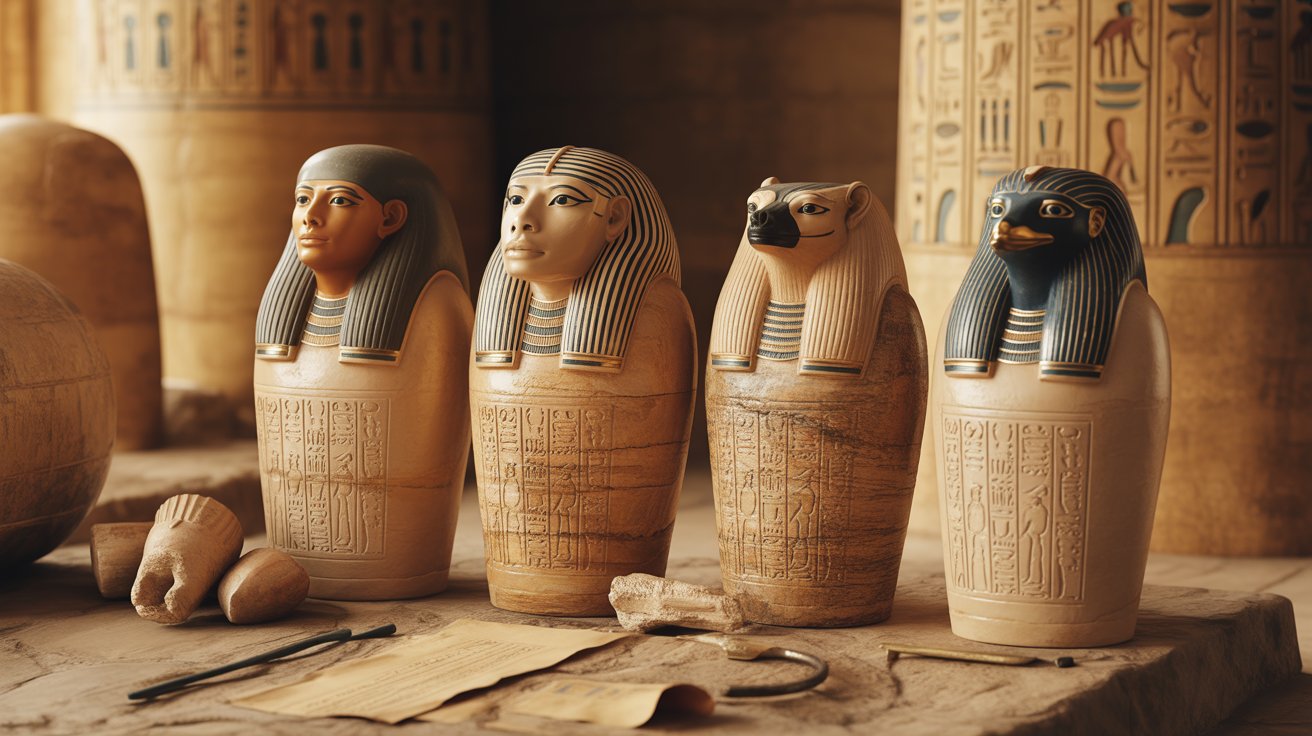
Egyptian Canopic Jars: Ancient Vessels of the Afterlife
When we think of ancient Egyptian mummification, images of wrapped bodies and golden sarcophagi often come to mind. But one of the most fascinating and essential elements of this sacred process were the canopic jars—specialized containers that played a crucial role in preparing the deceased for their journey to the afterlife.
What Are Canopic Jars?
Egyptian canopic jars were specialized vessels used during the mummification process to store and preserve the internal organs of the deceased. These mummification jars weren't just practical containers—they were deeply spiritual objects, each one protected by a specific deity and designed to safeguard vital organs for use in the afterlife.
The ancient Egyptians believed that the body needed to be preserved intact for the soul to recognize it in the afterlife. While the heart was left in the body (considered the seat of intelligence and emotion), other major organs were removed, preserved, and placed in these sacred vessels.
The Four Sons of Horus: Guardian Deities
One of the most remarkable canopic jars facts is that each jar was associated with one of the Four Sons of Horus, protective deities who guarded specific organs:
Imsety (human-headed jar) protected the liver and was associated with the south. This deity represented physical strength and was linked to the goddess Isis.
Hapy (baboon-headed jar) safeguarded the lungs and faced north. Despite the similar name, Hapy was distinct from the Nile god and was protected by the goddess Nephthys.
Duamutef (jackal-headed jar) held the stomach and was oriented to the east. This son of Horus was under the protection of the goddess Neith.
Qebehsenuef (falcon-headed jar) contained the intestines and pointed west. The goddess Serket served as his divine protector.
The Evolution of Mummification Jars
Canopic jars evolved significantly throughout ancient Egyptian history. During the Old Kingdom (around 2686-2181 BCE), these vessels had simple, flat lids. It wasn't until the Middle Kingdom that the iconic stoppers shaped like the Four Sons of Horus began to appear.
By the New Kingdom period, canopic jars reached their artistic peak, with exquisitely carved lids and beautifully decorated vessels. The finest examples were made from limestone or calcite (Egyptian alabaster), though pottery versions were more common for those of lesser means.
Interestingly, during the Third Intermediate Period, embalmers sometimes returned the organs to the body after treatment, but canopic jars were still placed in tombs as symbolic objects—a testament to their religious importance beyond practical function.
Materials and Craftsmanship
The materials used for Egyptian canopic jars varied based on the deceased's social status and wealth. Royalty and nobility enjoyed jars carved from precious limestone, alabaster, or even painted wood. These were often inscribed with protective spells from the Book of the Dead.
Common citizens typically received pottery or clay versions, which were nonetheless treated with the same religious reverence. Regardless of material, the jars were carefully sealed with lids that fit snugly to protect their contents for eternity.
The Mummification Process and Canopic Jars
The use of mummification jars was part of a complex 70-day process. After the body was washed and purified, embalmers would make an incision in the left side of the abdomen to remove the organs. Each organ was then washed, dried with natron (a natural salt), and treated with oils and resins.
The preserved organs were wrapped in linen before being placed in their respective canopic jars. The jars were then sealed and positioned in a special chest or shrine, often placed near the sarcophagus in the tomb. Some tombs featured a dedicated canopic shrine with four compartments, one for each jar.
Canopic Jars Facts: Fascinating Details
Here are some intriguing canopic jars facts that reveal the depth of ancient Egyptian beliefs:
The name "canopic" is actually a misnomer. It comes from the Greek city of Canopus, where locals worshipped Osiris in jar form. Early archaeologists mistakenly connected these worship vessels to the organ jars found in Egyptian tombs.
Not all organs received the canopic treatment. The brain was removed through the nose and discarded, as Egyptians didn't recognize its importance. The heart remained in the body because it would be weighed against the feather of Ma'at in the afterlife judgment.
Some royal burials included miniature canopic jars made of gold. King Tutankhamun's canopic shrine is one of the most spectacular examples, featuring a gold-covered shrine with an alabaster chest containing four miniature gold coffins for his organs.
Religious Significance and Symbolism
The four directions associated with each jar reflected the ancient Egyptian understanding of cosmic order. The placement of canopic jars in tombs followed strict cardinal directions, creating a protective barrier around the deceased.
Inscriptions on Egyptian canopic jars typically included prayers and spells to invoke the protection of the associated deity. These texts were meant to ensure that the organs remained preserved and functional for the resurrection in the afterlife.
The choice of animal heads for the lids wasn't arbitrary. Each animal held symbolic meaning: the baboon represented wisdom, the jackal connected to Anubis and embalming, the falcon symbolized Horus and kingship, and the human head represented humanity and divine protection.
Canopic Jars in Museums Today
Today, museums around the world display stunning examples of mummification jars. The British Museum, the Egyptian Museum in Cairo, and the Metropolitan Museum of Art house some of the finest collections. These artifacts provide invaluable insights into ancient Egyptian religious practices and artistic achievements.
Modern imaging techniques have even allowed researchers to examine the contents of sealed canopic jars without opening them, revealing fascinating details about ancient embalming techniques and the state of preservation achieved by these master embalmers.
The Legacy of Canopic Jars
Egyptian canopic jars represent more than just an ancient burial practice—they embody a civilization's profound beliefs about death, the afterlife, and the importance of preserving the body for eternity. These vessels demonstrate the sophisticated understanding ancient Egyptians had of anatomy and preservation, centuries before modern science.
The artistry and religious devotion evident in these mummification jars continue to captivate people worldwide. They stand as enduring symbols of ancient Egypt's complex relationship with mortality and their unwavering belief in life beyond death.
Whether you're a history enthusiast, a student of ancient civilizations, or simply curious about Egyptian burial practices, understanding canopic jars opens a window into one of history's most fascinating cultures. These sacred vessels remind us that the ancient Egyptians didn't just prepare for death—they prepared meticulously for eternal life.
Conclusion
Canopic jars facts reveal a civilization that viewed death not as an ending but as a transformation. Through these carefully crafted vessels and the elaborate mummification process they supported, ancient Egyptians demonstrated their belief that life continues beyond physical death. Today, these Egyptian canopic jars serve as powerful reminders of humanity's timeless desire to transcend mortality and the extraordinary lengths one civilization went to ensure their journey to the afterlife was successful.
The next time you see these distinctive jars in a museum or documentary, you'll appreciate not just their artistic beauty but the profound spiritual beliefs and remarkable preservation techniques they represent—a legacy that continues to fascinate us thousands of years later.
home
