
The Narmer Palette: Ancient Egypt's Most Important Historical Artifact
The Narmer Palette stands as one of ancient Egypt's most significant archaeological discoveries, offering a remarkable window into the birth of one of history's greatest civilizations. This ceremonial artifact, dating back over 5,000 years, continues to captivate historians, archaeologists, and enthusiasts with its intricate carvings and historical importance.
What Is the Narmer Palette?
The Narmer Palette is a large ceremonial cosmetic palette carved from a single piece of siltstone, measuring approximately 64 centimeters in height. Discovered in 1898 by British archaeologists James Quibell and Frederick Green at Hierakonpolis, the ancient Egyptian city of Nekhen, this remarkable artifact is believed to date to around 3100 BCE, placing it at the very beginning of Egypt's dynastic period.
Unlike ordinary cosmetic palettes used for grinding eye makeup, the Narmer Palette was clearly created for ceremonial purposes. Its elaborate decoration and significant size indicate it was commissioned to commemorate a momentous historical event rather than for everyday use.
The Story Carved in Stone
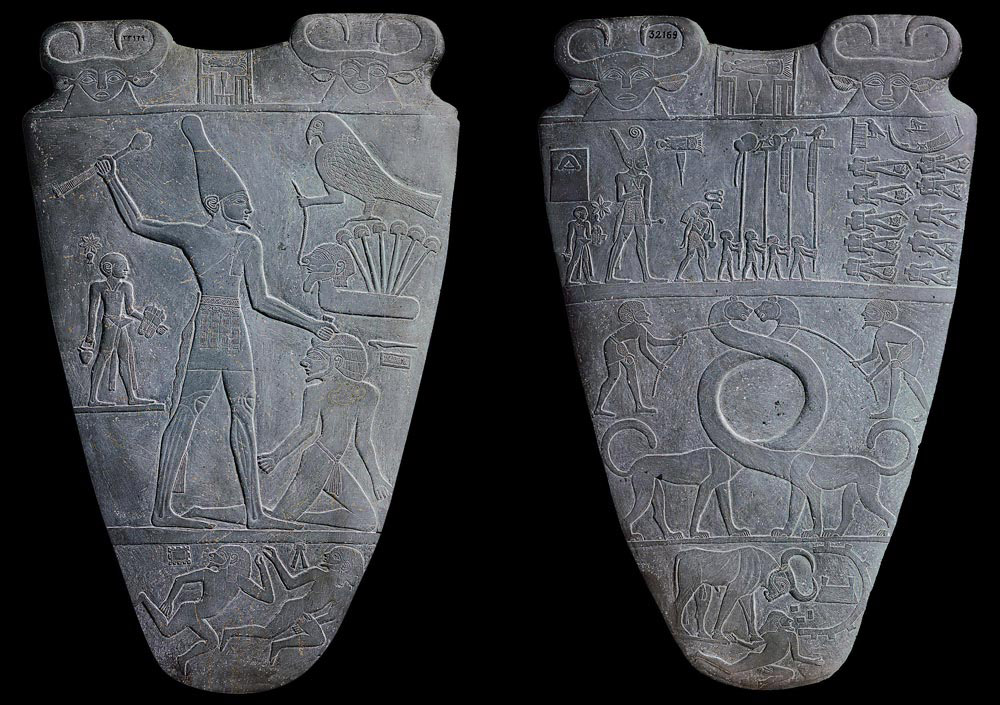
Both sides of the Narmer Palette feature intricate relief carvings that tell a powerful story. The obverse side depicts King Narmer wearing the White Crown of Upper Egypt, shown in the traditional pose of smiting an enemy with a mace. Below this central scene, two fallen enemies are portrayed, while at the top, the king's name appears in a serekh (palace facade) flanked by two bovine heads, likely representing the goddess Hathor.
The reverse side shows Narmer wearing the Red Crown of Lower Egypt, inspecting rows of decapitated enemies. A central circular depression, used for grinding cosmetics during ceremonies, is surrounded by two serpopards (mythical creatures with feline bodies and serpentine necks) whose intertwined necks form the palette's grinding area. At the bottom, a bull breaks through the walls of a fortified city, symbolizing the king's power.
Historical Significance of the Narmer Palette
The Narmer Palette holds immense importance for understanding early Egyptian history. Many scholars interpret it as commemorating the unification of Upper and Lower Egypt under a single ruler, marking the beginning of Egypt's First Dynasty and the start of pharaonic civilization as we know it.
The depiction of Narmer wearing both the White Crown and Red Crown on different sides of the palette suggests he ruled over a unified Egypt. This unification was a pivotal moment that would shape Egyptian civilization for the next three millennia, establishing the political and cultural framework that defined ancient Egypt.
Artistic and Cultural Impact
Beyond its historical value, the Narmer Palette represents a masterpiece of early Egyptian art. It establishes many artistic conventions that would persist throughout pharaonic history, including the hierarchical scale (showing important figures larger than others), the composite view of the human figure, and the use of registers to organize narrative scenes.
The palette also demonstrates the early development of Egyptian iconography and symbolism. The interplay of divine and royal imagery, the symbolic use of crowns, and the representation of enemies all became standard elements in Egyptian royal art and propaganda.
Where to See the Narmer Palette Today
The Narmer Palette is currently housed in the Egyptian Museum in Cairo, where it remains one of the museum's most prized possessions. Despite being over 5,000 years old, the artifact is remarkably well-preserved, allowing visitors to appreciate the skilled craftsmanship of ancient Egyptian artisans.
For those unable to visit Cairo, high-quality replicas and detailed photographs are available in museums worldwide, and the palette has been extensively documented in archaeological literature and digital archives.
Ongoing Debates and Interpretations
While widely accepted as commemorating Egypt's unification, the Narmer Palette continues to generate scholarly debate. Some researchers question whether Narmer and Menes (the legendary first king of unified Egypt) were the same person, while others debate the exact nature of the events depicted on the palette.
These ongoing discussions highlight how the Narmer Palette remains not just a historical artifact but an active subject of archaeological inquiry. Each generation of scholars brings new perspectives and methodologies to understanding this ancient treasure.
The Enduring Legacy
The Narmer Palette transcends its function as a ceremonial object to serve as a foundational document of Egyptian civilization. It bridges prehistory and history, myth and reality, art and politics. For anyone interested in ancient Egypt, archaeology, or the origins of complex societies, the Narmer Palette represents an essential piece of humanity's cultural heritage.
This single stone slab encapsulates a transformative moment when separate kingdoms became a unified nation, setting the stage for the pyramids, temples, and cultural achievements that would make ancient Egypt one of history's most influential civilizations. The Narmer Palette reminds us that even after five millennia, the stones of Egypt still speak to those willing to listen.
